
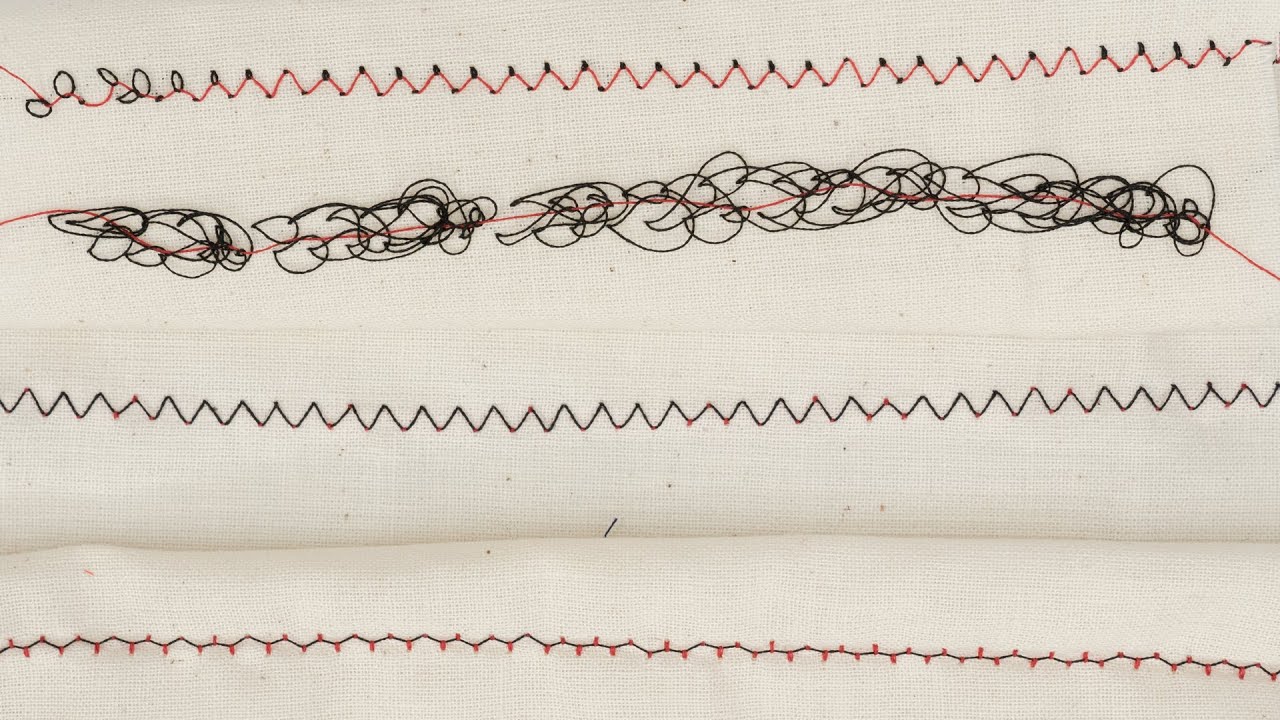
Most of the machines that arrive on our bench aren’t broken. They’ve got a threading fault, a tired needle, or a lint problem — and the owner has spent an hour fighting it before giving up.
So before you pack yours into the car, work through this. Nine times out of ten you’ll fix it in ten minutes.
Do this first, whatever the symptom. It solves more faults than everything else on this page put together.
If it’s still misbehaving, find your symptom below.
The classic “birds nest”. It looks like a bobbin problem because that’s where the mess is, but it almost never is one.
Cause: the top thread isn’t seated in the tension discs, so it feeds down unchecked and piles up underneath.
Fix: rethread the top with the presser foot up. Check the thread has gone properly into the take-up lever and hasn’t slipped out of the guide above the needle. Also check the spool isn’t catching — thread snagging on a chipped spool cap or a nick in the spool pin does the same thing.
Cause: usually the needle. Blunt, bent, fitted the wrong way round, not pushed fully up, or simply the wrong type for the fabric.
Fix: new needle first, correct type second. Jersey and knits need a ballpoint or stretch needle — a sharp universal pushes between the fibres instead of catching the loop. Denim and canvas need a heavier jeans needle.
If a fresh, correct needle doesn’t fix it, the hook timing has likely drifted and it’s a workshop job.
Cause: too much tension, a rough spot the thread is dragging over, or old thread.
Fix: rethread with the foot up, then check the needle is the right size for the thread — fine thread through a big needle flaps around, thick thread through a fine needle shreds. Look for burrs on the needle plate around the hole; a scratch there will saw through thread all day.
Worth saying plainly: old thread is a real cause. Thread found in a loft or inherited in a workbox goes brittle and snaps under no load at all. If it breaks when you pull a length between your hands, bin it.
Cause: bobbin wound badly, wrong bobbin for the machine, or lint in the case.
Fix: wind a fresh bobbin at a steady speed and check it looks even, not lumpy. Make sure it’s the right class of bobbin for your machine — generic multipacks are often a fraction out, and on Bernina and Janome models that’s enough to cause trouble. Clean the case out with a brush and a hoover attachment while it’s open.
Cause: something is deflecting the needle into metal.
Fix: check for the obvious combinations first — a zigzag stitch selected with a straight-stitch needle plate or foot fitted will snap needles instantly. Then check the needle size against the fabric; a fine needle through denim will bend and break.
The other big cause is pulling the fabric through. Let the feed dogs do the work — tugging bends the needle into the hook and, over time, knocks the timing out. That turns a 50p needle into a workshop bill.
Cause: something’s stopping the feed dogs doing their job.
Fix: run through these in order — is the presser foot actually lowered? Is the stitch length set above zero? Are the feed dogs dropped, or is the machine still in darning or free-motion mode from last time? Is a walking foot fitted without being attached properly?
If they’re up and moving but the fabric still isn’t shifting, the feed dogs are probably packed solid with lint.
Cause: too much tension for the fabric, or a needle that’s too heavy.
Fix: drop the top tension a little and try a finer needle. On lightweights — chiffon, viscose, fine cotton lawn — use a new fine sharp and put tissue paper or a light stabiliser underneath. Shortening the stitch length slightly can help too.
Cause: almost always threading, occasionally the bobbin case.
Fix: rethread top and bottom completely before touching a single dial. Use the same thread top and bottom for a test — different weights top and bobbin will never balance nicely. Then adjust the top tension only, in small steps, testing on scrap.
Leave the bobbin case screw alone unless you know what you’re doing. It’s a tiny adjustment with a big effect, and it’s the single most common thing we have to undo.
Cause: thread wrapped around the hook, or something seized.
Fix: stop. Don’t force the handwheel — you’ll bend or break something .
Unplug the machine, remove the needle and the bobbin case, and look for thread wound around the hook race. Ease it out gently with tweezers, cutting it rather than pulling if it’s tight. If nothing is visible and it’s still solid, leave it for us.
Cause: lint, dry parts, or timing.
Fix: a clean and a light oil (where your manual says to oil) fixes a lot of general rattle. But a knock, grind or clatter that’s new isn’t a cleaning problem — that’s the machine telling you something is out of adjustment or wearing. Book it in before it gets expensive.
One caution while you’re in there: if your machine has a plastic bobbin case, don’t oil the hook yourself. They’re generally designed to run dry, and oiling one can do damage. Leave that to a technician.
Some things aren’t home jobs. Bring it to us if:
That last one, unplug it and stop using it.
We work on all makes — Bernina, Janome, Brother, Husqvarna, Singer, Pfaff — including overlockers and embroidery machines. Bring it in and we’ll tell you what’s wrong before we do anything about it.
To get in contact call us on 01553 773362 or leave it with one of our service agents