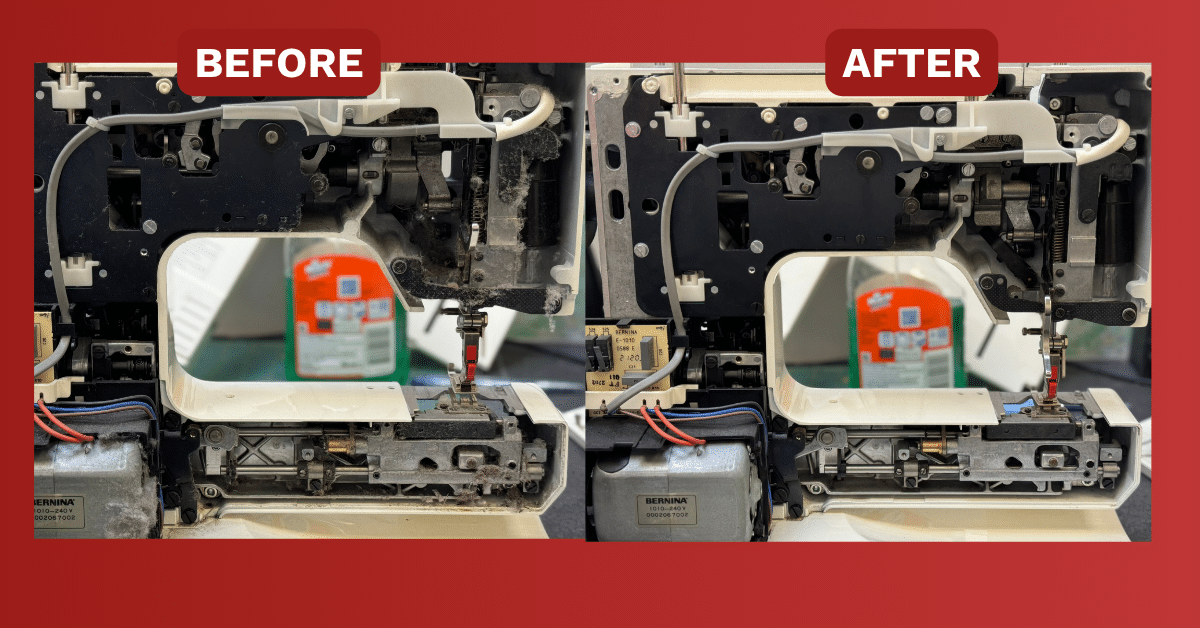
The short answer: every few years for most people. If you sew every day, or you’re running an embroidery machine hard, make it every year. If your machine lives in a cupboard and comes out twice a year, you can stretch it to every three years, but don’t stretch it further than that.
That’s the headline. The useful bit is knowing which of those you actually are, and how to spot a machine that’s asking for attention before it stops dead in the middle of a project.
A service interval based on the calendar is a rough guide. What actually wears a machine is running hours and the kind of work you put through it.
| How much you sew | Service every |
|---|---|
| Daily, or sewing for business | 12 months |
| A few times a week | 12-24 months |
| Once or twice a month | 24-36 months |
| Occasionally, stored away | Every 3 years |
Two things shorten those intervals regardless of hours:
Fluffy fabrics. Fleece, wadding, flannel, towelling and most quilting cottons shed constantly. Quilters and dressmakers working in fleece build up lint two or three times faster than someone sewing cotton poplin.
Storage conditions. A machine kept in a cold loft, garage or conservatory will pick up condensation. Damp plus old oil equals a stiff, sticky mechanism, and that turns up as skipped stitches long before you’d expect it.
You don’t need to wait for the anniversary. A machine tells you when it’s struggling:
Any two of those together and it’s time to book it in.
Lint isn’t just untidy. Compacted lint holds moisture and grinds against the hook race and feed dogs like a mild abrasive. Old oil turns gummy and drags on the motor. Neither is dramatic on its own — they just quietly move the machine out of adjustment until the timing goes which will stop you sewing!
Between services, you can handle:
One important exception on that last point: if your machine has a plastic bobbin case, don’t oil the hook yourself. These are generally designed to run dry or are self-lubricating, and adding oil can do real damage. Leave that one to a technician.
What you can’t do at home is check and reset the timing, adjust hook-to-needle clearance, test the motor and foot control under load, calibrate stitch settings on a computerised model, or replace worn belts and bushings. That’s bench work, and it’s most of what you’re paying for.
Embroidery machines earn their service more than anything else in the workshop. They run for hours at a stretch at high speed, they get used with stabiliser and dense stitch counts, and a timing problem doesn’t just spoil a seam — it wrecks a design you’ve already spent an hour on.
If you’re doing regular embroidery work, six to twelve months is sensible, not cautious.
Yes, and check your warranty terms before you decide otherwise. Some manufacturers expect the machine to have been serviced at set intervals, and a claim can be affected if it hasn’t been. It’s worth ten minutes with the paperwork.
Every machine that comes to our bench gets:
You get the machine back sewing the way it did when it was new, and you get told honestly if something needs replacing rather than finding out later.
We service all makes — Bernina, Janome, Brother, Husqvarna, Singer, Pfaff and the rest — including overlockers and embroidery machines.
Call us on 01553 773362 or view our servicing agents here
How much does a sewing machine service cost? It varies by machine type — a mechanical domestic machine, a computerised model and an embroidery machine are three different jobs. Get in touch and we’ll quote before any work starts.
How long does a service take? Typically 3 Weeks depending on how busy the workshop is and whether any parts are needed.
Can you service a machine you didn’t sell me? Yes. All makes and models, wherever you bought it.
My machine is 40 years old — is it worth servicing? Usually, yes. Older all-metal machines are often worth more after a service than a new budget machine costs, and parts are still available for some of them.